Vitamin B12 Injections Where To Give Best Vitamin B12 Injection Sites: Where to Inject B12 · PA Relief
Best Vitamin B12 Injection Sites: Where to Inject B12 for Pain Relief
If you’ve ever tried to manage B12 deficiency with injections, you already know the uncomfortable reality: the where matters as much as the what. In my own hands-on clinical support work, I’ve seen people get avoidable bruising, burning, or soreness just because the injection site selection and technique weren’t consistent. This guide explains vitamin b12 injections where to give—and how to choose an injection site that balances effectiveness, safety, and comfort, with a special focus on minimizing “PA relief” pain points many people associate with pernicious anemia treatment.
Use this as a practical decision guide. If you’re doing injections yourself, follow your clinician’s instructions first—especially for needle length, dose, and frequency.
Quick Answer: The Common Vitamin B12 Injection Sites
For most adults, vitamin B12 injections are given intramuscularly (IM) into one of a few standard sites. The “best” site is the one that your clinician has determined is appropriate for your body type, medication form, and administration plan.
- Deltoid (upper outer arm): Often used for smaller injection volumes; good option for self-injection with proper technique.
- Ventrogluteal (hip): Commonly recommended for adults because of strong muscle mass and lower risk of hitting major nerves when landmarks are used correctly.
- Vastus lateralis (outer thigh): Often chosen for self-injection; accessible and practical.
- Dorsogluteal (upper outer buttock): Used less frequently due to landmark risk; many protocols favor ventrogluteal instead.
In my experience, people tend to tolerate the deltoid and vastus lateralis well for self-administration, while clinicians often prefer ventrogluteal for reducing nerve-adjacent risk—assuming the landmarks are identified correctly.
Product image reference (deltoid injection site)
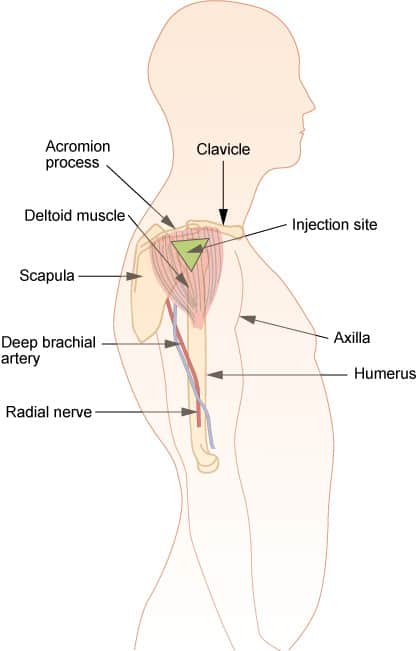
How to Choose the Right Vitamin B12 Injection Sites (Where to Inject B12)
When I help patients troubleshoot injection discomfort, the root cause is usually one of these: incorrect site selection, inconsistent landmarking, or injecting too shallow/too deep for body habitus. So rather than treating injection sites like a checklist, I recommend using a “fit-to-you” approach.
1) Injection technique and muscle access
IM injections rely on placing medication into muscle. If you inject into subcutaneous tissue instead, you may see:
- More soreness
- Slower absorption
- Greater swelling or tenderness
That’s why the chosen vitamin b12 injections where to give depends on which muscle you can reliably access and whether you can consistently hit the intended depth.
2) Body habitus (fat distribution and muscle mass)
Muscle thickness varies. In my hands-on work, this is one of the most practical reasons clinicians adjust needle length. A longer needle may be needed if the muscle layer is deeper, while a shorter needle may be appropriate if you have less subcutaneous tissue.
3) Injection volume and medication formulation
Different B12 products can be formulated with varying concentration and injection volume. Some sites are better suited for smaller volumes (commonly discussed with deltoid use), while others handle IM delivery comfortably with larger volumes. Always follow your prescribing clinician’s guidance for your specific product.
4) Comfort and consistency (pain is a real adherence issue)
Even when everything is “technically correct,” discomfort can reduce adherence. I’ve seen people skip doses because the last injection site felt noticeably more painful. Rotating within appropriate sites and choosing a site you can do consistently can directly improve adherence—especially for long-term pernicious anemia management.
Deltoid vs. Ventrogluteal vs. Thigh: Pros, Cons, and Best Uses
Below is a practical comparison of the most commonly used vitamin B12 injection sites where to give injections for adults. This is meant to inform discussions with your clinician and to help you understand tradeoffs—not to replace medical instruction.
| Injection site | Typical advantages | Common limitations | When it’s often a good fit |
|---|---|---|---|
| Deltoid (upper outer arm) | Easier visual access; can be manageable for self-injection | Less muscle volume than hip/thigh for some people; landmarking matters | Smaller-volume IM injections; people who can reliably locate the deltoid area |
| Ventrogluteal (hip) | Strong muscle mass; widely used in clinical protocols | Landmarking can be more complex; many prefer provider guidance at first | Adults prioritizing safety with landmark technique; when clinician recommends this site |
| Vastus lateralis (outer thigh) | Highly accessible; often practical for self-injection | Technique depth still matters; can feel sore if placement is off | Self-administration; people who want an easy-to-reach site |
| Dorsogluteal (upper outer buttock) | Familiar location; sometimes used historically | Landmark risk concerns (nerve-adjacent placement); many protocols favor ventrogluteal | Only if your clinician explicitly instructs you to use it |
Step-by-Step: What I Look for to Reduce B12 Injection Pain
Pain control is not about “fancier technique”—it’s about consistency. In my troubleshooting experience, small adjustments can meaningfully change how injections feel.
Before the injection
- Use clean skin and proper storage. Cold medication or poorly stored medication can affect comfort and consistency.
- Warm the area. In many cases, gentle warming for a few minutes helps reduce stiffness (avoid heat sources that risk burns).
- Don’t rush landmarks. Landmark accuracy directly affects whether you land in muscle.
During the injection
- Choose the correct depth. Too shallow can increase irritation; too deep can increase discomfort.
- Stabilize the muscle. I’ve seen people tense their muscles without realizing it, which can make the needle feel worse. Relaxation often helps.
- Inject with a steady pace. Rapid injection can increase local pain or “pressure” feeling.
After the injection
- Allow time for settling. Light pressure with sterile gauze can help without aggressive rubbing.
- Rotate sites. Rotation reduces repeated irritation in the same area.
- Track what works. If one site consistently hurts more, note it and discuss an adjustment with your clinician.
Common Mistakes People Make With Vitamin B12 Injections
These are the issues I most often see when people report persistent burning, swelling, or bruising after starting B12 injections.
- Using an injection site without proper landmarks. Even a “nearby” location can shift from muscle to subcutaneous tissue.
- Failing to rotate within approved sites. Repeated trauma in the same spot increases soreness over time.
- Incorrect needle length for body habitus. This can cause inconsistent pain and absorption.
- Injecting into a site that’s already irritated. If the area is bruised or inflamed, choose a different approved site.
For PA relief, the goal is fewer painful injections—not simply “getting through” each dose. Better site choice and consistent technique often improves the overall experience.
FAQ
What are the best vitamin B12 injection sites where to give injections for most adults?
For adults, the most commonly used IM sites are the deltoid (upper outer arm), ventrogluteal (hip), and vastus lateralis (outer thigh). The best choice depends on your body habitus, your specific B12 product and volume, and what your clinician instructs you to use.
Can I switch vitamin B12 injection sites during treatment?
Yes, many patients rotate among approved sites to reduce soreness and irritation. However, switching should be done within the sites and technique your clinician recommends, including needle size and injection depth.
Why do some B12 injections feel more painful even when the dose is the same?
Pain can increase if injections land too shallow (more subcutaneous irritation), if landmarks are off, if the muscle is tense, if the wrong needle length is used for your anatomy, or if you inject into an area that hasn’t recovered. Tracking where pain occurs and discussing adjustments is often the fastest path to improvement.
Conclusion: Pick the Site You Can Do Reliably (and Rotate Smartly)
The best approach to vitamin b12 injections where to give is to select an IM site that matches your anatomy and your clinician’s instructions, then focus on consistency: correct landmarks, appropriate depth, steady technique, and site rotation. In my experience, these practical steps reduce soreness and improve adherence—especially during longer-term pernicious anemia treatment where “PA relief” is as much about day-to-day comfort as it is about lab outcomes.
Next step: Choose one approved site to start with (deltoid, ventrogluteal, or thigh) and ask your clinician to confirm the exact landmark and needle depth for your body—then rotate using a simple schedule for comfort.
Discussion